
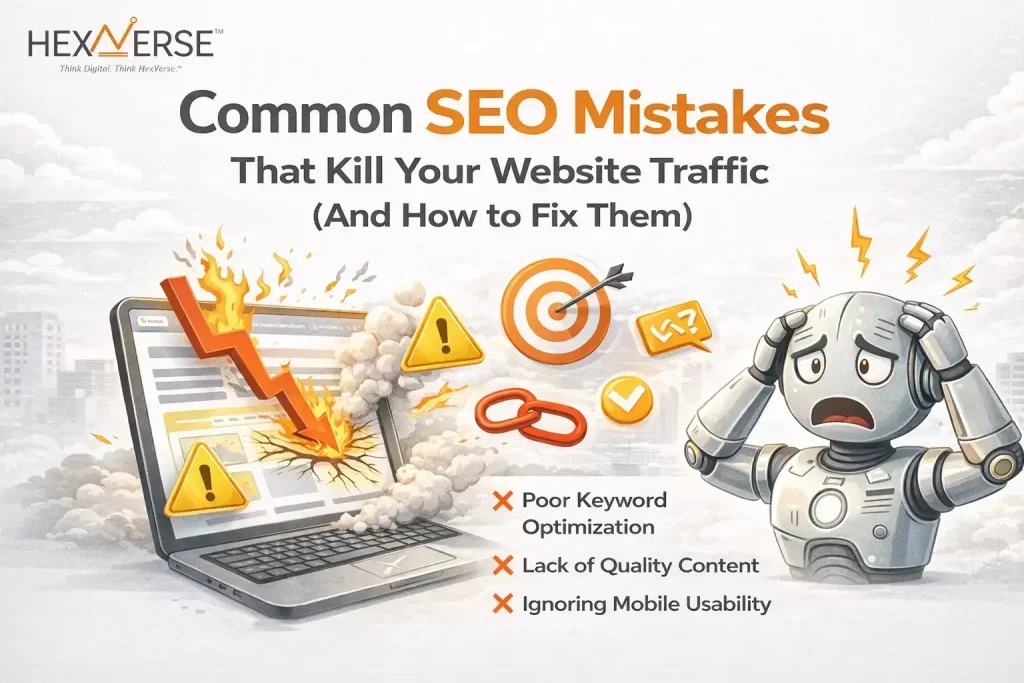
Common SEO Mistakes That Kill Your Website Traffic (And How to Fix Them)
If your website isn’t attracting enough traffic or visitors are leaving quickly, chances are you’re making Common SEO Mistakes That Kill Your Website Traffic. Even small errors can hurt your search rankings, reduce leads, and slow down business growth. In this guide, we’ll discuss the most common SEO mistakes and actionable ways to fix them, helping your website rank better on Google and boost traffic.
15 Common SEO Mistakes to Avoid as a Digital Marketer
The most important factor in increasing organic traffic to your website is ranking highly in search results. You should anticipate fewer page views the farther you are from the top spot. Avoiding common SEO mistakes, which can cost you both traffic and profits, is the best way to rank highly in search results.
1. Choosing the Wrong Keywords
The most important factor in increasing organic traffic to your website is ranking highly in search results. You should anticipate fewer page views the farther you are from the top spot. Avoiding common SEO mistakes, which can cost you both traffic and profits, is the best way to rank highly in search results. The cornerstone of successful SEO is keywords. These are the terms and expressions that users type into the search bar in order to locate your content. The biggest SEO error you can make is concentrating on the incorrect keywords. Because they believe it will increase traffic, a lot of people choose high-volume keywords. High-volume keywords, however, are frequently very competitive, making it nearly impossible for a smaller website.
Generic terms like “vegan” are too general. Instead, to identify pertinent keywords that complement your content and target the search intent of your audience, you must conduct sophisticated keyword research. One or two words that are more specific than generic keywords are known as “fat head” keywords.
But it’s usually better to concentrate on long-tail keywords. It is easier to rank higher with long-tail keywords because they are three to five words long, much more specific, and less competitive. You could target the long-tail keyword “easy vegan Instantpot recipes” or the fat-tail keyword “low-carb vegan” in place of the generic “vegan” keyword.
You could target the long-tail keyword “easy vegan Instantpot recipes” or the fat-tail keyword “low-carb vegan” in place of the generic “vegan” keyword.
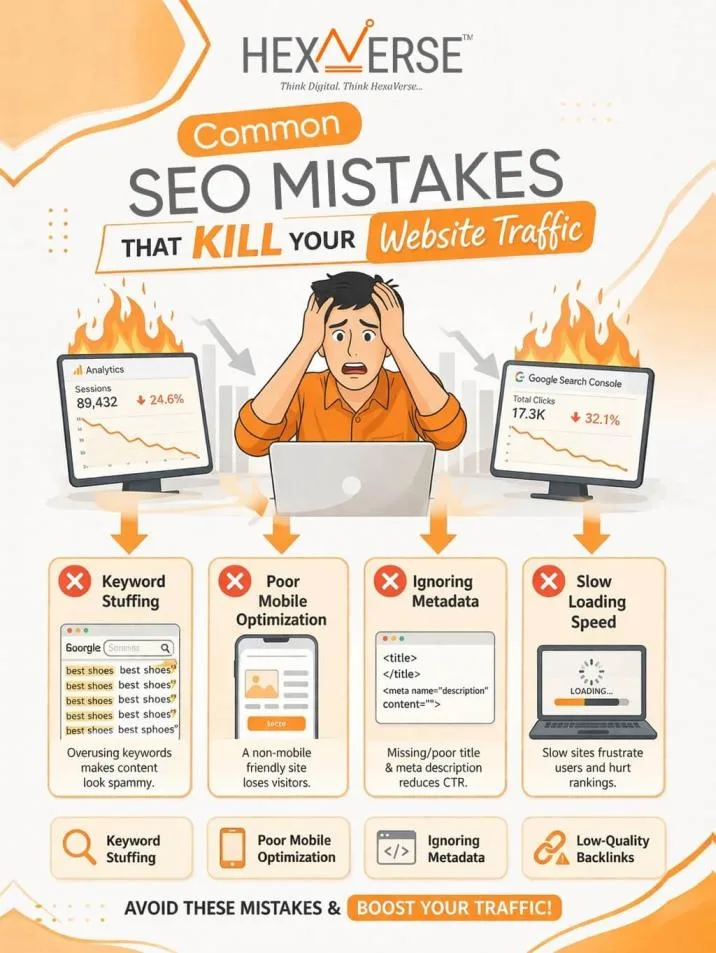
2. Keyword Stuffing
You might be tempted to use the ideal keyword or phrase as frequently as possible in your content once you’ve selected it. Avoid using too many keywords on a page in an attempt to raise its search engine ranking.
Although it may have had some success in the early days of search engines, this antiquated tactic is no longer effective. Nobody enjoys reading the same long-tail keywords over and over. It sounds strange and unnatural, and Google’s new algorithm prioritizes useful content created by people for people.
Keyword stuffing is easily detected and penalized by search engines such as Google. Focus on producing excellent, pertinent content that organically uses keywords rather than stuffing it full of them. This method guarantees that your content is both search engine optimized and interesting and educational.
3. Ignoring Your Audience and Their Buyer Journey
Even if you have the ideal keyword, you must present it to your audience at the appropriate time. Attracting the appropriate traffic at the appropriate time is your goal. People who are just learning about your brand shouldn’t be subjected to a forceful sales pitch. You can better tailor your content to your audience’s needs, preferences, and stages of the buyer journey.
Provide “top of the funnel” content for those who are just starting to learn about the subject and are considering their options. You can produce content that is more sales-driven and highlights the fantastic qualities of your product or service for customers who are nearing the end of the customer buying travel and are ready to buy something.
Building trust and directing your audience toward conversion can be achieved by producing content that answers queries and concerns at different phases. Ignoring this factor may draw visitors who aren’t prepared to interact or convert; as a result, they may quickly depart and possibly never return to your brand. By tracking awareness KPIs like share of voice and positive and negative brand mentions, you can gain a better understanding of where consumers are in their relationship with your brand.
4. Not Having a Backlink Strategy
When you are praised by others, people are impressed, and Google is no exception.
Links pointing to your website from external sources are referred to as backlinks. They can generate referral traffic and are a type of social capital. Backlinks, particularly those from reputable companies, inform search engines that your content is reliable and valuable. Search engines will give your content more weight if they notice links to it from other big, reputable websites.
When you are praised by others, people are impressed, and Google is no exception. Links pointing to your website from external sources are referred to as backlinks. They can generate referral traffic and are a type of social capital. Backlinks, particularly those from reputable companies, inform search engines that your content is reliable and valuable. Search engines will give your content more weight if they notice links to it from other big, reputable websites.
Regardless of how valuable and well-written your content is, it will be more difficult to achieve that desired top spot in rankings without high-quality backlinks. The following should be part of your backlink strategy:
Producing worthwhile, viral content
- Blogging as a guest
- Broken link construction
- Internal connections
- Making use of social media
- Applying the “HexaVerse” Method
5. Forgetting Technical SEO
In order for search engines to efficiently crawl and index your pages, technical SEO optimizes the technical aspects of your website. Ignoring technical SEO can result in problems like:
- Slow loading times for pages
- Broken connections
- Your website isn’t being ranked or indexed
- Unsatisfactory user experience
To increase your website’s visibility and performance in search results, regularly audit it for technical SEO problems and quickly address them.
6. Having Duplicate Content
It’s simple to believe that having more content on your website is preferable. Duplicate content, however, can confuse readers and search engine crawlers, which is a problem for SEO.
Duplicate content appears on several pages of your website and is either exactly the same or very similar. Google won’t be able to determine which of your two articles titled “How to Perfectly Press Your Work Shirts” to index. This conundrum may weaken and dilute your rankings.
Make sure your website has original, worthwhile content on every page. Additionally, you should use canonical tags to let search engines know which version of a page is preferred. Maintain the authority and ranking of your website by routinely identifying and removing duplicate content.
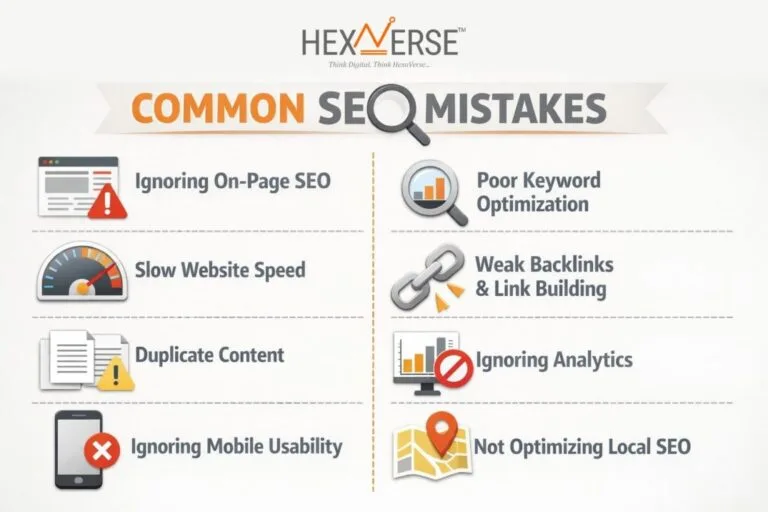
7. Not Using Mobile-first Design
Mobile devices account for more than 85% of Internet traffic in the United States. Google indexes and ranks content primarily using its mobile version, a practice known as mobile-first indexing.
7. Not Using Mobile-first Design
Mobile devices account for more than 85% of Internet traffic in the United States. Google indexes and ranks content primarily using its mobile version, a practice known as mobile-first indexing.
Your website will have higher bounce rates and lower search engine rankings if it is a magnificent sight to behold on a large desktop monitor but confusing and challenging to navigate on a smartphone. A clear, uncomplicated design that is simple to use even on a palm-sized screen will benefit you.
Ensure that your website loads efficiently and provides a seamless experience on mobile devices. Make use of touch-friendly buttons and larger fonts as mobile-friendly design elements. Make mobile-first design a top priority to boost the SEO performance of your website.
8. Google Search Intent
Your website will fail regardless of how well-optimized it is for particular keywords if you don’t comprehend the purpose of the keywords. If you’re focusing on the keywords “fencing near me,” you should find out if the people who are looking for that want to learn a new sport or enclose their backyard.
The purpose of a user’s query and their desired outcome are known as their search intent. Content that doesn’t satisfy user needs can result in lower engagement and higher bounce rates if search intent isn’t understood and addressed.
Four primary categories of search intent exist:
- Educational
- Navigating
- Transactional
- Business
Your content will be more valuable and relevant if it is created with the user’s search intent in mind, which will result in higher rankings.
9. Not Checking Your Site’s Crawlability
In order to determine rankings, search engines employ automated programs known as crawlers to follow links on the Internet and store them in a database. The ease with which search engine bots can access and index your website is known as crawlability.
Search engines may overlook crucial pages and refrain from indexing your website if it is difficult for these bots to navigate. If you’re not indexed, it’s impossible to rank highly, even though it’s difficult when you are.
Typical problems that impair crawlability include:
· Broken links
· Poor site architecture
· Blocked resources in your robots.txt file
Crawlability issues can be found and resolved with the aid of tools like Google Search Console. To make it easier for search engines to index your pages, your website should have a logical and clear structure, functional links, and easily accessible resources.
10. Not Doing Thorough Competitor Analysis
You can learn what works and what doesn’t in your industry by observing what your rivals are doing. Since your uniqueness is what makes you valuable, you definitely don’t want to imitate their tactics exactly. Nonetheless, competitor analysis enables you to find content gaps, backlink tactics, and keyword
Opportunities that you may not have noticed or discovered.
You can improve your own SEO strategy and obtain a competitive advantage by analyzing the advantages and disadvantages of your rivals. Utilize tools for keyword analysis, such as SEMrush, to examine the backlinks, content, and keywords of your rivals and develop strategies to increase the number of qualified visitors to your website.
11. Having Low-Quality Content on Your Pages
If you’re going to produce subpar content, there’s no point in using SEO techniques to rank highly. Low engagement and high bounce rates are the results of poorly written or unhelpful content. When visitors depart from your website quickly, search engines take note and reduce your ranking.
In the end, search engines look for well-researched and educational content so users can find a thorough response to their queries.
You can produce excellent content by concentrating on components like:
- Extensive investigation
In the end, search engines look for well-researched and educational content so users can find a thorough response to their queries.
You can produce excellent content by concentrating on components like:
- Thorough research
- Clear and concise writing
- Explanatory images and videos
- Relevant links to more authoritative information
- Updating content regularly with new information
12. Not Optimizing Images
Images that are compelling can help you communicate your message and attract more visitors. Large, uncompressed images, however, slow down your pages and make them less responsive, which will quickly drive away visitors. Your bounce rate will rise by 32% if your page loads in just one to three seconds. On the Internet, people don’t want to wait for large images to load.
By using the following techniques to optimize your images, you can reduce your load time:
- Compress files to reduce sizes
- Use descriptive file names
- Include alt-text
- Make sure your images are optimized for a great appearance on mobile devices.
13. Ignoring Page Speed
Although optimizing your images will speed up the loading of your page, there are other factors to consider. Both user satisfaction and your chances of ranking higher in search results are enhanced by a website that loads quickly. When assessing your page speed, there are two primary metrics to take into
account.
First Contentful Paint (FCP)
This is how long it takes for the first piece of content—whether it be text or an image—to appear on the screen. It’s the earliest time a user can engage with your website. By providing users with visual cues that the website is loading, FCP lessens the impression of load time and decreases the likelihood that they
- will click away out of frustration.
The following factors can delay the First Contentful Paint:
- Render-blocking resources from Javascript and CSS
- High network latency
- Slow server speed
- Large, uncompressed image files
Time to First Byte (TTFB)
The time between the user’s request and the browser’s first byte of the response is known as the TTFB. It includes the speed at which the server and browser establish and process a connection, as well as the speed at which the domain name is converted to an IP address.
- TTFB can be slowed down by the following factors:
- Poor server performance
- Low-quality network conditions
- Back-end processing is slow.
To find performance bottlenecks, you can use tools like Google Lighthouse to analyze the speed of your website.
14. Forgetting to Add Metadata
Title tags and meta descriptions are examples of metadata that provide search engines with information about the content of your page and have an impact on click-through rates (CTR) from search results. Metadata is used by search engines to index and present data about your website. It helps browsers understand and display your content correctly.
Your title tags ought to be succinct and informative. Remember to incorporate your targeted keywords into your metadata.
Every webpage on your website should have an engaging meta description that appropriately summarizes the content of the page. This will show up below your webpage’s title in search engine results.
15. Not Monitoring Your Organic Search Traffic
Increasing organic search traffic is the goal of search engine optimization, so unless you monitor your progress, you won’t know if your efforts are paying off. You can learn how users are finding your website, which keywords are generating traffic, and how well your SEO tactics are working by routinely examining your traffic data.
You can learn more about your organic search traffic by using tools like Google Analytics and Google Search Console. To find areas for improvement, monitor important metrics like conversion rate, session length, and bounce rate. You can make data-driven decisions to enhance your SEO efforts with the aid of these figures. Additionally, you’ll be able to adjust to shifts in user behavior and search engine algorithms for long-term success.
Don’t Make These SEO Mistakes
To rank well on Google, you must take a multi-layered approach to address all of the factors. Start by examining your website and fixing the most significant SEO errors you discover. You can work on other items on the list as you gain control over those. To learn more about how to get to the top of search engine results pages, schedule a free strategy session.
Frequently Asked Questions (FAQs)
1. What are the common SEO mistakes that kill website traffic?
Common SEO mistakes include poor keyword optimization, duplicate content, slow website speed, ignoring mobile usability, weak backlinks, neglecting meta tags, and outdated content. These mistakes prevent search engines from ranking your website and reduce organic traffic.
2. How can I fix common SEO mistakes on my website?
To fix SEO mistakes, optimize keywords, create original and high-quality content, improve website speed, make your site mobile-friendly, build quality backlinks, update meta tags, and regularly refresh old content. Monitoring with Google Analytics helps track improvements.
3. Why does ignoring mobile usability reduce website traffic?
Mobile devices account for more than 60% of all online traffic. Websites that are not mobile-friendly provide poor user experience, leading to high bounce rates and lower search engine rankings. Ensuring your site is responsive improves traffic and rankings.
4. How does duplicate content affect SEO and traffic?
Duplicate content weakens the authority of your website and confuses search engines. It can prevent pages from ranking properly and lead to lower organic traffic. Always create unique content and use canonical tags for similar pages.
5. Can slow website speed kill my SEO?
Yes. Slow-loading websites frustrate users and increase bounce rates, which negatively affects search rankings. Optimizing images, enabling caching, and using fast hosting can significantly improve speed and traffic.
6. How do weak backlinks affect website traffic?
Backlinks are a key SEO ranking factor. Weak or spammy backlinks reduce domain authority, limiting search engine visibility and organic traffic. Focus on earning high-quality, relevant backlinks.
7. What is the best way to track and prevent SEO mistakes?
Use tools like Google Analytics and Google Search Console to monitor traffic, ranking, and user behavior. Conduct regular SEO audits to identify issues like broken links, missing meta tags, and slow pages.
8. How often should I update my website content to avoid losing traffic?
Regularly updating content ensures relevancy and keeps pages optimized for current keywords. Refresh blogs, product pages, and service pages every few months, especially if your industry trends change.
9. Are meta tags important for SEO?
Yes, meta titles and descriptions help search engines understand your page content and influence click-through rates in search results. Neglecting them can reduce traffic and rankings.
10. How long does it take to fix SEO mistakes and see traffic improvement?
Minor fixes like optimizing meta tags, improving speed, or correcting keywords may show results in a few weeks. Bigger changes, like content overhauls and link building, usually take 2–6 months for noticeable traffic growth.